Drone pull-back over a finished barn, school building behind. 8–12 sec silent loop. Farmersville or Callisburg. Poster frame from same clip serves mobile.
50+ Texas school ag facilities built. One team handles the barn and everything in it.
The usual way
A district hires a general contractor with a strong record — gyms, field houses, admin buildings. Good people. They've just never built a wash rack that drains right, or hung a gate a 14-year-old can work by herself with a steer on the other side of it.
Then the equipment goes out for bid separately, months later, to somebody who's never set foot on the site.
And somewhere in the middle of all that, the ag teacher becomes the project manager. She's the one catching the pen spacing problem at 4:30 on a Friday — because she's the only person on the job who knows what happens in that building at six in the morning during show season.
How this team is put together
Site work, dirt, utilities, foundation, structure, electrical, plumbing, ventilation. Bonded for multiple projects at once, with school district work underway right now.
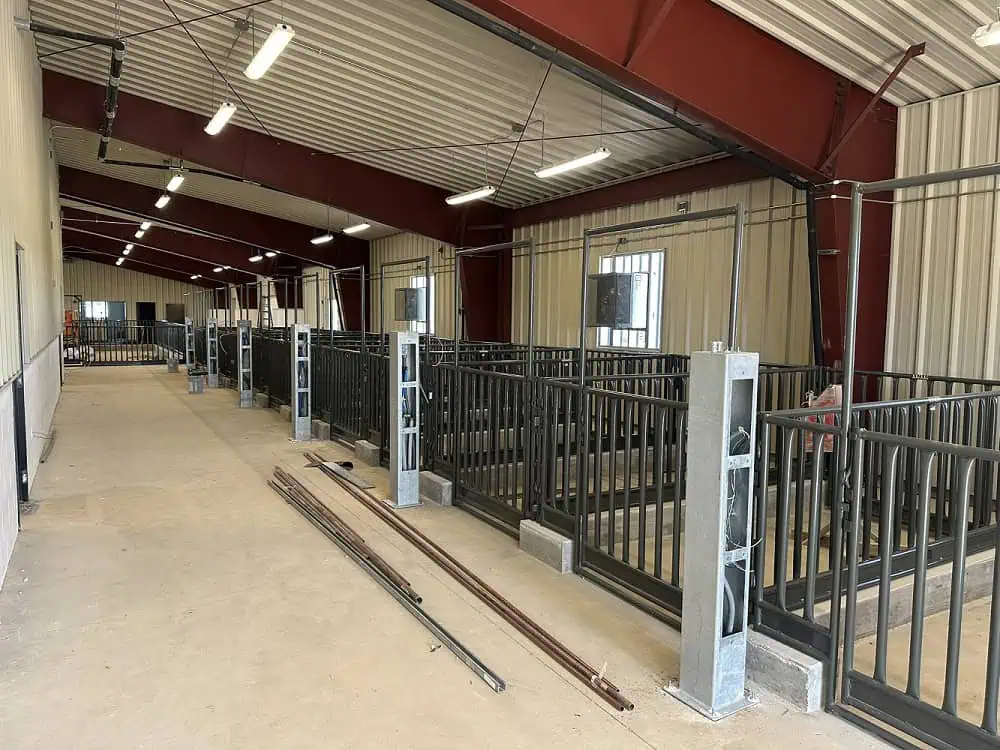
Pens, gates, panels, wash bays, feed rooms, alleyways, chutes, student feed lockers, show arena layout. Building ag facilities across Texas since 1995.
The difference isn't that we do both. It's that we plan both together, before the slab gets poured — when moving a drain still costs a pencil mark instead of a change order.
What's in a school farm
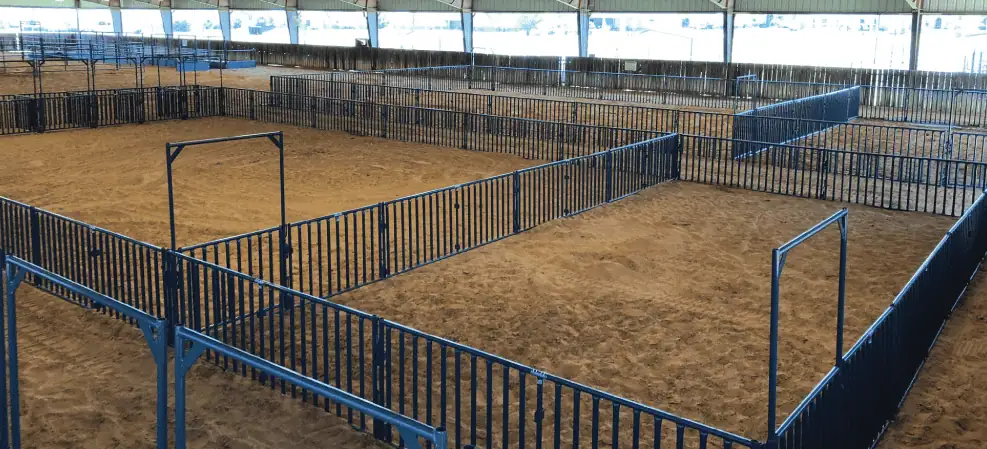
Sized for the animals your kids actually show, with gates and headgates a student can handle safely without waiting on an adult.
Pen configurations, feeders, and fitting space scaled right — instead of leftover corners in a barn designed for cattle.
Pens, waterers, and wash-down built for daily use by a rotating crew of teenagers, not for a photo on opening day.
Cage systems and airflow planned for a Texas summer, when the difference between good and bad ventilation is measured in lost animals.
Slope, drains, and hose placement worked out on the drawing rather than discovered the first time somebody rinses a steer.
A locker with a name on it. Small thing on a drawing. Ask an ag teacher how much it matters in October.
Trim chutes, fitting areas, and arena space sized for practice and for hosting — not sized to become storage by year two.
Sometimes one project serves the district and the county both. We've built those, and we'll help you sort out what each side needs.
Proof
Callisburg ISD · Ag facility
Farmersville ISD · Ag facility
Jarrell ISD · Interior equipment
Katy ISD · Multi-barn campus
Whitewright ISD · Facility
District name · What was built
Pull-quote slot. One sentence from an ag teacher or superintendent at a district already built. Highest-value single item on this page — a superintendent trusts another district more than any vendor.
Name · Title · DistrictHow districts buy it
Both companies hold purchasing cooperative contracts. Your district can buy the structure and the equipment through contracts that have already been competitively procured — instead of running a full bid cycle for the building, then another one for everything inside it.
One project. One purchasing path. No gap in the middle where the district has to referee between two vendors who've never worked together.
We'll also help scope a bond package before the money exists, so the number you take to voters is a number that still works when you go to build.
MLT carries bonding capacity for several projects at once, so your district isn't waiting in line behind somebody else's barn.
Timeline
Nobody in a district cares whether it takes 140 days or 180. They care whether the barn is usable before county show.
Scope, budget, drawings, purchasing path. Done the year before dirt moves.
Site work and foundation start the week after school lets out. No heavy equipment sharing a campus with students.
Building goes up and equipment gets set as spaces finish — not in a separate trip three months later.
Kids start projects when school starts, instead of halfway through the semester.
Fully operational for county show and the majors, the first year it opens.
Every project runs on its own schedule — weather, bond timing, and site conditions all move it. Walk your site with us and we'll give you real dates, not a template.
Who you're hiring
Questions we get
Yes. Plenty of districts add on or renovate rather than start over. We'll walk it with you and tell you honestly which one makes more sense — including when the answer is "keep what you've got and fix three things."
Yes, and earlier is better. A realistic number in the bond ask beats a surprise after it passes. We'd rather help you get the number right than get called after the money's already committed.
Then that's what you buy. Either company works standalone. The joint venture exists because most districts need both — not because we'll only sell it that way.
Morgan Livestock Equipment. Same people who set it, with parts on the shelf. You're not chasing a manufacturer in another state.
Yes. Sometimes the same project serves the district and the county both, and we'll help you sort out what each side needs and who pays for what.
Texas, Oklahoma, Louisiana, New Mexico, and Arkansas are where we work day to day. We go further when the project calls for it — and because both companies hold TIPS contracts, districts anywhere in the country can purchase through them. If you're outside the five, call and ask.
Walk your site with us. We'll tell you what it takes, what it costs, and what we'd do first. No charge for the conversation.
Form slot — name, district, role, county, what you're building, timeline. Keep phone numbers visible: ag teachers call, they don't fill out forms.